
The Randle Cycle Explained
Introduction
Every second of every day, your cells are making thousands of tiny decisions about how to produce energy.
Should they burn glucose from your last meal? Fat stored in adipose tissue? Fatty acids circulating in the bloodstream? Or ketones produced by the liver?
Many people assume the body burns all of these fuels equally at the same time. In reality, that would be remarkably inefficient.
Instead, cells are designed to prioritize one major fuel source over another depending on nutrient availability, hormonal signals, and energy demand. This process is governed by a fundamental metabolic principle known as the Randle Cycle, or the glucose-fatty acid cycle.
First described in the 1960s by British physiologist Philip Randle, the Randle Cycle explains how the oxidation of one fuel naturally suppresses the oxidation of another. When fat oxidation increases, glucose utilization decreases. When glucose oxidation predominates, fat oxidation is temporarily reduced.
This is not a flaw in human metabolism.
It is one of the body's most elegant mechanisms for maintaining energy efficiency.
Over time, however, this normal physiological process has often been misunderstood. Some have argued that fat "causes" insulin resistance because it reduces glucose oxidation, while others claim that carbohydrates prevent fat burning. In reality, the Randle Cycle describes a normal and reversible metabolic adaptation—not necessarily a disease state.
Understanding this distinction is essential for making sense of topics such as insulin resistance, metabolic flexibility, ketogenic diets, exercise physiology, and type 2 diabetes.
In this article, we'll explore what the Randle Cycle is, why it exists, how it helps cells regulate fuel selection, and why separating normal physiology from metabolic disease is critical for understanding human metabolism.
🎧 Listen to the Episode: Why Your Body Can't Burn Fat and Sugar at the Same Time
Your metabolism constantly makes a choice between burning glucose and burning fat—and understanding that decision changes the way you think about nutrition, exercise, fasting, and insulin resistance.
In this episode of The Health Pulse, we explain the Randle Cycle, uncovering how fuel selection influences energy levels, metabolic flexibility, and long-term metabolic health.
▶️ Click play below to listen, or keep reading to discover why one of the most important principles in metabolism has remained surprisingly absent from most conversations about nutrition and health.
What Is the Randle Cycle?
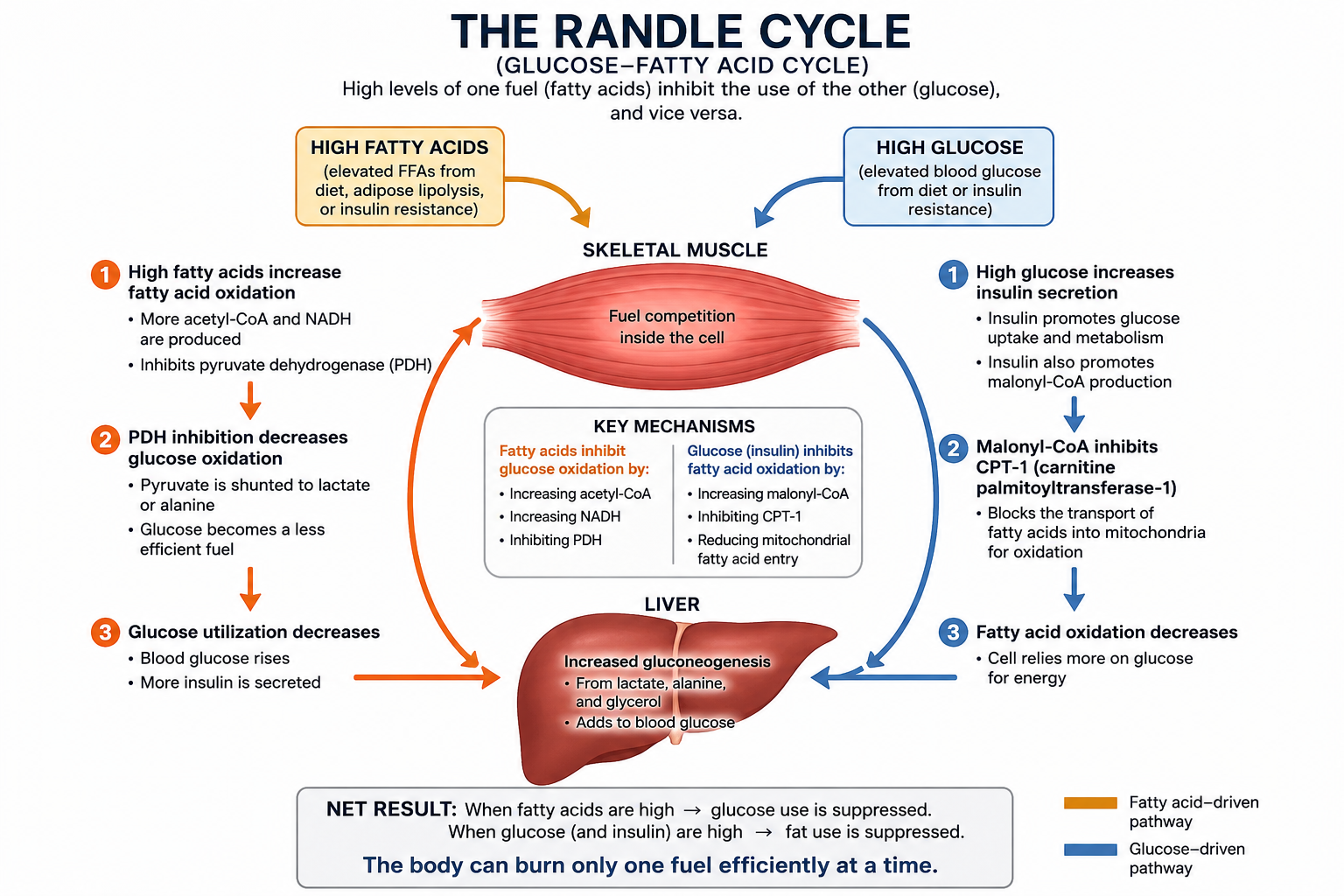
The Randle Cycle, also known as the glucose-fatty acid cycle, describes the competition between glucose and fatty acids as fuel sources inside the cell.
The concept is surprisingly simple.
When fat oxidation increases, the cell naturally reduces glucose oxidation. Conversely, when glucose oxidation increases, fat oxidation decreases.
This is not because one fuel is harmful to the other. It is because cells are designed to avoid running two major energy programs at full speed simultaneously.
Think of it like a hybrid vehicle.
Although a hybrid car can use both gasoline and electricity, it does not operate both systems at maximum output all the time. Instead, it continuously adjusts which energy source is most efficient for the current driving conditions.
Your cells behave in much the same way.
After a carbohydrate-rich meal, insulin rises and glucose becomes abundant. Muscle and other tissues preferentially increase glucose uptake and oxidation, while fat oxidation is temporarily suppressed.
Several hours later, as insulin levels decline and glucose availability decreases, adipose tissue begins releasing fatty acids into the bloodstream. Mitochondria shift toward beta-oxidation, and glucose utilization naturally falls.
During prolonged fasting or nutritional ketosis, this shift becomes even more pronounced as fatty acids and ketones supply much of the body's energy needs.
This continual switching between fuels is a hallmark of metabolic flexibility.
At the cellular level, the Randle Cycle is regulated through several biochemical checkpoints.
As fatty acid oxidation increases, the production of acetyl-CoA, NADH, and citrate rises. These molecules signal that sufficient energy is already being generated from fat, slowing key enzymes involved in glucose metabolism, particularly pyruvate dehydrogenase (PDH) and phosphofructokinase (PFK).
The opposite occurs when glucose oxidation predominates. Elevated insulin increases glucose uptake while suppressing lipolysis, reducing the availability of fatty acids and shifting metabolism toward carbohydrate oxidation.
The important point is that the Randle Cycle is not a disease process. It is one of the body's normal mechanisms for matching fuel selection to nutrient availability.
The key question is not whether fat suppresses glucose oxidation or glucose suppresses fat oxidation—they both do. The more important question is whether the body can switch between these fuels efficiently when metabolic conditions change. That ability is what defines metabolic flexibility and distinguishes healthy metabolism from metabolic dysfunction.
The Randle Cycle Is Normal Physiology—Not Insulin Resistance
One of the biggest misconceptions surrounding the Randle Cycle is the belief that because fatty acid oxidation reduces glucose oxidation, fat must therefore cause insulin resistance.
This is an oversimplification.
The Randle Cycle describes physiological insulin resistance, a normal, reversible adaptation that allows the body to prioritize one fuel over another depending on metabolic conditions.
Consider what happens during an overnight fast.
As insulin levels fall, adipose tissue releases fatty acids into the bloodstream. Skeletal muscle begins oxidizing these fatty acids, reducing its reliance on glucose. Consequently, muscles take up less glucose—not because they have become diseased, but because they simply no longer need as much glucose for energy.
This is an intelligent metabolic adaptation.
By conserving glucose, the body ensures that tissues with an absolute or greater need for glucose—such as certain regions of the brain, red blood cells, and parts of the kidney—continue to receive an adequate supply.
The same phenomenon occurs during nutritional ketosis.
As fatty acids and ketones become the primary fuels, skeletal muscle intentionally reduces glucose utilization. This glucose-sparing effect is often referred to as adaptive glucose sparing or physiological insulin resistance, and it is fundamentally different from the pathological insulin resistance seen in type 2 diabetes.
In type 2 diabetes, insulin resistance develops in a very different metabolic environment.
Instead of low insulin and efficient fat oxidation, there is often:
Chronic hyperinsulinemia
Excess energy availability
Mitochondrial stress
Ectopic fat accumulation
Chronic inflammation
Oxidative stress
Under these conditions, insulin signaling becomes impaired while blood glucose and insulin remain chronically elevated. This is not a normal fuel-selection mechanism—it is a manifestation of metabolic dysfunction.
Confusing these two states has led to considerable misunderstanding in both research and public discussions about metabolism.
The key point is that reducing glucose oxidation is not inherently pathological. Healthy skeletal muscle decreases glucose utilization whenever fat is the more appropriate fuel. The problem arises only when the body loses its ability to transition back and forth between fuels as metabolic conditions change.
This distinction is critical because the hallmark of good metabolic health is not constantly burning glucose or constantly burning fat—it is maintaining the flexibility to efficiently use either fuel when needed.
The Randle Cycle and Exercise
Exercise provides one of the clearest demonstrations of the Randle Cycle in action.
The fuel your muscles use during physical activity depends largely on the intensity and duration of the exercise. Rather than relying exclusively on glucose or fat, muscles continuously adjust fuel selection to match the rate at which ATP is required.
During low-intensity activities such as walking, easy cycling, or light jogging, ATP demand is relatively modest. Mitochondria have sufficient time to oxidize fatty acids, allowing fat to provide a large proportion of the energy required.
As exercise intensity increases, however, the situation changes.
High-intensity exercise requires ATP to be generated much more rapidly than fat oxidation alone can provide. Muscle fibers therefore increase glucose utilization because glucose can be metabolized at a faster rate, particularly through glycolysis.
This shift is completely normal.
The body is not "stopping fat burning" because fat is harmful. It is selecting the fuel that can best meet the immediate energy demand.
Elite endurance athletes provide an excellent example of metabolic flexibility.
Years of endurance training increase mitochondrial density, improve fat oxidation, and allow athletes to continue using substantial amounts of fat even at relatively high exercise intensities. This helps preserve glycogen stores and delays fatigue during prolonged events.
Resistance training also improves metabolic flexibility, though through somewhat different mechanisms. By increasing muscle mass, enhancing insulin sensitivity, and stimulating mitochondrial adaptations, strength training expands the body's overall capacity to utilize both glucose and fatty acids efficiently.
Exercise also demonstrates that the Randle Cycle is highly dynamic.
Within minutes, muscles can shift from primarily burning fat while walking to predominantly using glucose during a sprint, then return to greater fat oxidation during recovery. This rapid switching is one of the clearest signs of a healthy metabolic system.
The key point is that the Randle Cycle allows muscles to continuously select the most appropriate fuel for the task at hand. Exercise does not break the Randle Cycle—it showcases how elegantly the body adjusts fuel selection in response to changing energy demands.
What Happens When Metabolic Flexibility Is Lost?
The Randle Cycle is designed to help the body switch efficiently between glucose and fat oxidation. In a metabolically healthy individual, this transition occurs seamlessly as nutrient availability and energy demands change.
The problem arises when this flexibility begins to disappear.
In the early stages of insulin resistance, chronically elevated insulin suppresses lipolysis, limiting the release of fatty acids from adipose tissue. As a result, the body becomes increasingly dependent on glucose for energy, even though it may have abundant fat stores.
At the same time, years of nutrient excess begin to overwhelm mitochondria.
Cells are continuously exposed to glucose, fatty acids, and insulin, creating a state of metabolic overload. Rather than switching cleanly between fuels, mitochondria are forced to process an almost constant influx of energy substrates. This contributes to oxidative stress, impaired mitochondrial function, and a gradual decline in metabolic efficiency.
Skeletal muscle is particularly affected.
As the body's largest insulin-sensitive tissue, muscle normally acts as the primary site for glucose disposal after a meal. When muscle becomes insulin resistant, glucose uptake declines, forcing the pancreas to secrete even more insulin to maintain normal blood glucose levels.
This creates a vicious cycle:
Hyperinsulinemia suppresses fat oxidation.
Reduced fat oxidation increases glucose dependence.
Glucose disposal becomes less efficient.
Insulin secretion rises further.
Mitochondrial stress and oxidative stress continue to increase.
Eventually, the body's ability to transition between fuels becomes severely impaired.
Many people begin experiencing symptoms such as:
Frequent hunger between meals
Energy crashes
Sugar cravings
Difficulty fasting
Reduced exercise tolerance
These symptoms often reflect an underlying loss of metabolic flexibility rather than a simple lack of willpower.
It is important to recognize that the Randle Cycle itself is not causing metabolic disease.
The cycle is functioning exactly as it was designed.
The pathology lies in the metabolic environment. Chronic hyperinsulinemia, persistent nutrient excess, mitochondrial dysfunction, and inflammation prevent the normal transitions between fuels that characterize healthy metabolism.
The key point is that metabolic disease is not the result of the Randle Cycle—it is the result of losing the flexibility that allows the Randle Cycle to function properly. Healthy metabolism is defined not by burning one fuel exclusively, but by maintaining the ability to efficiently use whichever fuel best matches the body's needs.
How Lab Testing Can Help Assess Fuel Metabolism
The Randle Cycle itself cannot be measured with a routine blood test. It is a dynamic physiological process occurring inside cells every second, continuously adjusting fuel selection according to hormones, nutrient availability, and energy demand.
However, laboratory testing can identify many of the metabolic conditions that influence how effectively the Randle Cycle operates.
One of the most informative markers is fasting insulin.
Chronically elevated fasting insulin often indicates hyperinsulinemia and early insulin resistance, even when fasting glucose remains within the normal range. Because insulin strongly influences whether the body burns glucose or fat, fasting insulin provides valuable insight into an individual's metabolic flexibility.
Markers of glucose regulation—including fasting glucose and HbA1c—help assess long-term carbohydrate metabolism. While these tests do not directly measure fuel switching, they reveal how effectively the body is maintaining glucose homeostasis over time.
Continuous glucose monitoring (CGM) can provide an even deeper understanding. By observing glucose responses throughout the day, patients can see how meals, physical activity, sleep, and stress affect glucose regulation, offering practical insight into overall metabolic health.
Lipid markers also contribute to the picture.
Elevated triglycerides, low HDL cholesterol, and increased ApoB frequently accompany insulin resistance and impaired metabolic flexibility. These changes often reflect an underlying metabolic environment in which normal fuel regulation has become disrupted.
Liver function tests deserve attention as well. Fatty liver disease is closely associated with hyperinsulinemia and impaired substrate metabolism, making ALT and AST useful markers when interpreted alongside other metabolic tests.
Because skeletal muscle is the primary site of glucose disposal after meals, preserving muscle mass through resistance training and regular physical activity remains an essential component of maintaining healthy fuel metabolism. Laboratory results should therefore always be interpreted within the broader context of body composition and lifestyle.
At QuickLab Mobile, we help patients evaluate these metabolic patterns through comprehensive at-home lab testing in Miami. Our panels assess fasting insulin, glucose regulation, lipid profiles, ApoB, liver function, inflammatory markers, and other biomarkers that help identify metabolic dysfunction long before type 2 diabetes or cardiovascular disease develops.
The goal is not to measure the Randle Cycle directly. The goal is to identify the metabolic environment that determines whether the body can efficiently switch between glucose and fat—the hallmark of true metabolic flexibility.
Conclusion
The Randle Cycle is one of the most fundamental principles of human metabolism, yet it is often misunderstood. Rather than describing a disease process, it explains how healthy cells intelligently choose between glucose and fatty acids to maximize energy efficiency.
Every day, your metabolism shifts between different fuel sources. After a meal, insulin promotes glucose utilization. As insulin falls between meals, fatty acid oxidation increases. During prolonged fasting or nutritional ketosis, ketones become an additional source of energy. These transitions are not signs of metabolic dysfunction—they are hallmarks of a healthy, adaptable metabolism.
Problems arise only when this flexibility is lost.
Chronic hyperinsulinemia, persistent overnutrition, physical inactivity, mitochondrial dysfunction, and inflammation can gradually impair the body's ability to transition between fuels. Instead of smoothly switching from glucose to fat and back again, metabolism becomes increasingly rigid, contributing to insulin resistance, fatty liver disease, type 2 diabetes, and cardiovascular disease.
Understanding the Randle Cycle also helps clarify an important misconception. Temporarily reducing glucose oxidation while burning fat is not the same as pathological insulin resistance. Physiological fuel selection is a normal adaptation that occurs during fasting, exercise, and nutritional ketosis. Pathological insulin resistance, by contrast, develops in the setting of chronic metabolic dysfunction and impaired metabolic flexibility.
The goal of metabolic health is therefore not to burn carbohydrates all the time or fat all the time. It is to preserve the ability to efficiently use whichever fuel best matches the body's needs.
At QuickLab Mobile, we help patients evaluate many of the metabolic factors that influence this process through comprehensive at-home lab testing in Miami. By assessing fasting insulin, glucose regulation, ApoB, lipid profiles, liver function, and inflammatory markers, patients can identify metabolic dysfunction early and monitor improvements over time.
The Randle Cycle reminds us that metabolism is not a battle between carbohydrates and fat. It is a highly coordinated system designed to maintain energy efficiency and metabolic resilience. Protecting that flexibility may be one of the most important steps toward preventing chronic disease.
👉 Book Your Test Now
Watch Professor Ben Bikman Explain the Randle Cycle
The Randle Cycle can seem like a complex biochemical concept, but Professor Ben Bikman does an excellent job of breaking it down into clear, practical terms. In this presentation, he explains how cells regulate the use of glucose and fatty acids, why this competition between fuels is a normal feature of human metabolism, and how understanding the Randle Cycle can help clarify common misconceptions about insulin resistance and metabolic health.
As you watch, pay attention to the distinction between physiological fuel selection—a healthy adaptation that allows the body to efficiently switch between energy sources—and pathological insulin resistance, which develops when metabolic flexibility is lost. This perspective provides an important foundation for understanding many of the topics discussed throughout this article.
Disclaimer:
The information provided in this blog, podcast, and associated content is for educational and informational purposes only and is not intended as a substitute for professional medical advice, diagnosis, or treatment. The content shared is based on reputable sources, medical literature, and expert insights, but it should not be used as a replacement for direct consultation with a licensed healthcare provider.
No Doctor-Patient Relationship: Engaging with this content does not create a doctor-patient relationship between you and QuickLabMobile or any contributors. Always consult with a qualified physician, specialist, or healthcare professional before making any medical decisions, changing your treatment plan, or starting/stopping any medications.
Not a Substitute for Medical Advice: While we strive to provide accurate and up-to-date information, medicine is constantly evolving. New research, treatments, and medical recommendations may emerge, and individual health conditions can vary. Do not rely solely on this content for health decisions. If you are experiencing symptoms, have concerns about your health, or require medical assistance, seek immediate care from a licensed medical professional.
Emergency Situations: If you are experiencing a medical emergency, such as difficulty breathing, chest pain, signs of a stroke, or any other life-threatening condition, call 911 (or your local emergency services) immediately. Do not delay seeking emergency care based on information provided here.
Liability Disclaimer: QuickLabMobile, its contributors, and any associated entities do not assume liability for any damages, harm, or adverse outcomes resulting from the use, interpretation, or misuse of the information provided in this content. You are responsible for your own healthcare decisions and should always verify information with a trusted medical professional.
External Links & References: This content may include links to external sources, medical studies, or third-party websites for further reading. These links are provided for convenience and informational purposes only. QuickLabMobile does not endorse, control, or take responsibility for the accuracy of external content. Always verify information with authoritative sources such as the CDC, NIH, WHO.
Final Note: Your health is unique, and what works for one person may not be suitable for another. Stay informed, ask questions, and always prioritize professional medical guidance