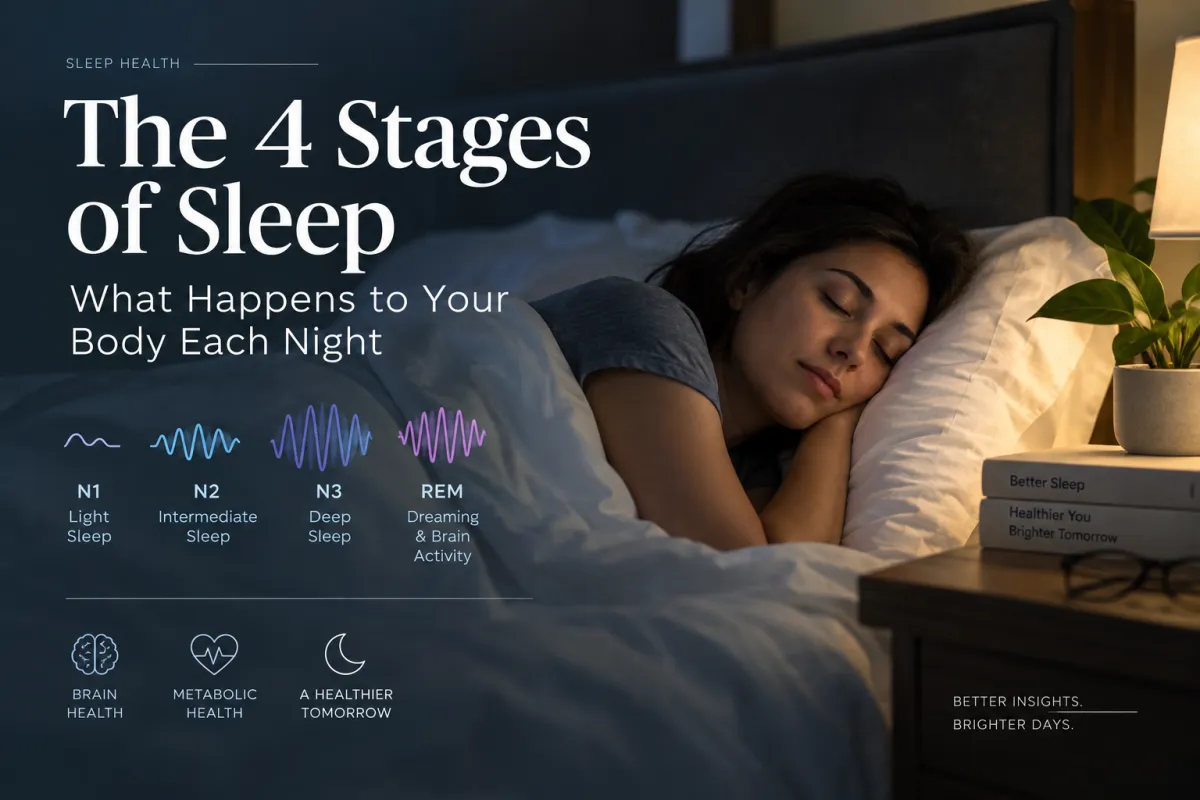
The Stages of Sleep: What Happens to Your Body Each Night
Introduction
Sleep is not a single, continuous state. Throughout the night, the brain cycles through several distinct stages, each with characteristic patterns of brain activity, eye movement, muscle tone, breathing, and heart rate.
Sleep is divided into non-rapid eye movement (NREM) sleep and rapid eye movement (REM) sleep. NREM is further divided into three stages: N1, N2, and N3. N1 marks the transition from wakefulness into sleep, N2 represents a more stable stage of sleep, and N3 is the deepest stage, characterized by slow-wave brain activity. REM sleep is physiologically different: brain activity increases, vivid dreaming becomes more common, and most skeletal muscles are temporarily inhibited.
These stages occur in repeating cycles throughout the night. Although sleep cycles are often described as lasting 90 minutes, their length varies, and the composition of each cycle changes as the night progresses. Deep N3 sleep is concentrated more heavily in the first part of the night, while REM periods generally become longer toward morning.
This organization—known as sleep architecture—is one reason sleep quality cannot be judged by duration alone. Two people may both sleep for eight hours while experiencing very different amounts of deep sleep, REM sleep, awakenings, and sleep fragmentation.
Those differences can matter beyond simply feeling rested. Sleep interacts with memory, learning, immune function, cardiovascular regulation, glucose metabolism, insulin sensitivity, appetite, and hormonal signaling. When normal sleep is repeatedly shortened or disrupted, these systems can also be affected.
Understanding sleep therefore requires looking beyond the number of hours spent in bed. To understand what the body is doing overnight, we first need to understand how a normal sleep cycle is organized.
🎧 Listen to the Episode: The Reason You Wake Up Tired
Sleep isn't eight hours of the same biological state. Throughout the night, your brain moves through an organized sequence of light sleep, slow-wave sleep, and REM, with each stage appearing in different proportions as morning approaches.
In this episode of The Health Pulse, we break down sleep architecture from adenosine and circadian rhythms to sleep spindles, deep sleep, REM, and sleep fragmentation. We also explore why disrupted sleep can affect cortisol, appetite, insulin sensitivity, and daytime energy, and where wearable sleep trackers can—and cannot—help.
▶️ Click play below to listen, or keep reading to discover why feeling rested depends not only on how long you sleep, but on what your brain gets to accomplish while you're there.
How a Sleep Cycle Works
Sleep unfolds in repeating cycles rather than progressing through each stage only once. A typical cycle moves from lighter NREM sleep into deeper sleep and then eventually into REM sleep, before the process begins again.
A simplified sequence looks like this:
Wakefulness → N1 → N2 → N3 → lighter NREM sleep → REM
The exact pattern varies, and brief awakenings can occur between cycles without being remembered the next morning.
An adult sleep cycle is often described as lasting about 90 minutes, but this is only an approximation. Individual cycles commonly vary in length, and their composition changes throughout the night. Most adults complete roughly four to six cycles during a full night's sleep.
The first several cycles contain proportionally more N3, or deep slow-wave sleep. As morning approaches, N3 becomes less prominent while REM periods become progressively longer. This is why cutting sleep short in the morning can disproportionately reduce REM sleep, while disruption earlier in the night may interfere more with deep sleep.
The transition between these stages is controlled by two interacting systems. Sleep pressure builds the longer we remain awake, partly through the accumulation of adenosine. At the same time, the body's circadian clock helps determine when the brain is biologically prepared for sleep or wakefulness.
Together, these systems influence when we fall asleep, how deeply we sleep, and how sleep stages are distributed across the night.
To understand what is actually changing during those cycles, we can start with the brief transition between wakefulness and sleep: Stage N1.
Stage N1: The Transition Into Sleep
N1 is the lightest stage of NREM sleep and represents the transition between wakefulness and established sleep. It usually occupies only a small portion of the night.
As N1 begins, awareness of the environment decreases, muscles relax, eye movements become slow, and brain activity shifts away from the faster patterns associated with wakefulness. On an EEG, alpha activity decreases and lower-frequency theta activity becomes more prominent.
Because sleep is still very light, a person in N1 can usually be awakened easily and may even insist they were not asleep.
This is also the stage in which hypnic jerks can occur—the sudden sensation of falling accompanied by an involuntary muscle contraction. These are common and usually harmless.
N1 is primarily a transitional stage. If sleep continues without interruption, the brain generally moves within minutes into N2, where sleep becomes more stable and distinctive electrical patterns begin appearing in the brain.
Stage N2: Stable Sleep
N2 is the second stage of NREM sleep and usually accounts for the largest portion of an adult's total sleep time. At this point, the body is more clearly asleep: heart rate slows, breathing becomes more regular, body temperature falls, and awareness of the external environment decreases.
The defining features of N2 appear in brain electrical activity. Two patterns are particularly important: sleep spindles and K-complexes.
Sleep spindles are brief bursts of rapid brain activity generated through interactions between the thalamus and cerebral cortex. They appear to help protect sleep from external disturbances and are also associated with learning and memory consolidation.
K-complexes are large, distinctive brain waves that can occur spontaneously or in response to sounds and other stimuli. They may help the brain evaluate incoming information without fully waking the person.
This makes N2 more than simply a bridge between light and deep sleep. The brain remains capable of monitoring the environment while simultaneously maintaining sleep and processing information from the day.
As N2 progresses, the body becomes increasingly disconnected from the external environment. If sleep deepens further, the brain enters N3—the slow-wave stage commonly known as deep sleep.
Stage N3: Deep Sleep
N3 is the deepest stage of NREM sleep and is commonly called slow-wave sleep because the EEG becomes dominated by large, low-frequency delta waves.
During N3, heart rate and breathing slow, blood pressure falls, and the body becomes highly relaxed. A person is much harder to awaken than during N1 or N2, and waking abruptly from deep sleep can produce temporary confusion and grogginess known as sleep inertia.
N3 is strongly associated with physical recovery. Growth hormone secretion is concentrated during slow-wave sleep, supporting tissue repair and other restorative processes. Deep sleep is also involved in immune regulation, memory processing, and metabolic function.
Slow-wave sleep is particularly abundant during the first part of the night. As the night progresses, N3 periods generally become shorter while REM periods become longer.
Certain sleep disorders can also emerge from deep NREM sleep. Sleepwalking, sleep terrors, and confusional arousals typically arise from N3 rather than REM sleep, which is why a person experiencing them may have little or no memory of the event afterward.
Deep sleep also changes with age. Children generally experience considerably more slow-wave sleep, while the amount tends to decline as people get older.
After progressing through deeper NREM sleep, the brain eventually moves toward a very different state—one in which brain activity becomes surprisingly active while most voluntary muscles become temporarily inhibited: REM sleep.
REM Sleep: When the Brain Becomes Highly Active
REM, or rapid eye movement sleep, is physiologically very different from NREM sleep. Brain activity increases and begins to resemble certain features of wakefulness, even though the person remains asleep.
As the name suggests, the eyes make rapid movements beneath the eyelids. Heart rate and breathing become more variable, and vivid, story-like dreams are particularly common during this stage—although dreaming can also occur during NREM sleep.
One of the most distinctive features of REM is muscle atonia. The brain temporarily suppresses activity in most skeletal muscles, preventing many of the movements imagined during dreams from being physically performed. The muscles responsible for breathing and several other essential functions remain active.
REM sleep also plays an important role in memory consolidation, learning, and emotional processing. Research suggests that NREM and REM contribute differently but cooperatively to how the brain processes and integrates information acquired while awake.
REM periods are relatively short early in the night and become progressively longer toward morning. This means consistently cutting sleep short can disproportionately reduce REM sleep, even when total sleep loss appears modest.
REM completes the major stages of the sleep cycle, but the amount of time spent in each stage is not constant. Sleep architecture changes across the night—and throughout life.
How Sleep Stages Change Throughout the Night
Sleep architecture is not evenly distributed across the night. Although the brain repeatedly cycles through NREM and REM sleep, the composition of those cycles changes as sleep progresses. N3 deep sleep is concentrated primarily in the earlier cycles, when homeostatic sleep pressure is greatest after a day of wakefulness. As the night continues, N3 generally becomes less prominent, while REM periods become progressively longer and more frequent toward morning. N2 usually accounts for the largest proportion of total sleep in healthy adults, while N1 occupies a relatively small amount. The exact percentages vary with age, individual biology, recent sleep history, medications, alcohol use, illness, and other factors.
This changing pattern is important when considering sleep restriction, but it is more complicated than simply saying that losing the first two hours eliminates deep sleep while losing the last two hours eliminates REM. Sleep stages are actively regulated by both homeostatic sleep pressure and the circadian system. Because the brain has a strong drive for slow-wave sleep after prolonged wakefulness, delaying bedtime while keeping the same wake time can lead to some redistribution and preferential preservation of N3 rather than simply deleting the first stages that would normally have occurred. By contrast, waking substantially earlier can more directly eliminate part of the REM-rich portion of the sleep period. Either pattern can disrupt normal architecture when it becomes chronic, even if the effects on individual stages are not identical.
Sleep architecture also changes across the lifespan. Children generally experience considerably more slow-wave sleep, while N3 tends to decline with age. Older adults often experience lighter, more fragmented sleep with more frequent awakenings, although there is substantial individual variation. Sleep disorders can further alter this organization. Obstructive sleep apnea, for example, can repeatedly interrupt sleep as breathing becomes impaired, forcing the brain into brief arousals and preventing normal progression through consolidated sleep cycles.
This is why time in bed, total sleep time, and restorative sleep are not interchangeable concepts. Someone may spend eight hours in bed but experience repeated awakenings that fragment NREM and REM sleep, while another person may sleep continuously for most of the same period. Healthy sleep depends not only on getting enough hours, but also on maintaining sufficient continuity for the brain to repeatedly progress through its normal sequence of sleep stages.
What Happens When Sleep Architecture Is Disrupted?
Normal sleep depends on the brain being able to move repeatedly through NREM and REM cycles with relatively few interruptions. Sleep fragmentation occurs when that continuity is repeatedly disrupted by brief awakenings or arousals. Some are long enough to remember, but many last only seconds and may occur dozens or even hundreds of times without the person realizing it. As a result, someone can spend seven or eight hours in bed and still wake feeling unrefreshed because the architecture of sleep was repeatedly interrupted.
Many factors can fragment sleep. Obstructive sleep apnea is an important example: repeated narrowing or collapse of the upper airway can reduce airflow, alter oxygen and carbon dioxide levels, and trigger brief arousals that restore breathing but interrupt sleep. Pain, reflux, frequent urination, restless legs syndrome, environmental noise, stress, alcohol, and certain medications can also disrupt normal sleep. Alcohol is particularly misleading because it can shorten the time required to fall asleep while later producing more fragmented sleep and altering normal REM and NREM organization.
The consequences extend beyond daytime sleepiness. Experimental sleep restriction and fragmentation can increase sympathetic nervous system activity, alter cortisol and other hormonal rhythms, impair glucose regulation, and affect appetite and cardiovascular function. Slow-wave sleep appears particularly relevant to metabolic regulation: experimental disruption of deep sleep has been associated with reduced insulin sensitivity even when total sleep duration was not dramatically shortened. This suggests that sleep quality and architecture may influence metabolism independently of simply counting hours asleep.
At the same time, individual sleep-stage percentages should not become another number people feel obligated to optimize. There is no universal requirement to achieve a particular percentage of deep or REM sleep every night, and normal architecture varies with age and circumstances. More importantly, consumer wearables can only estimate sleep stages. When persistent snoring, witnessed breathing pauses, excessive daytime sleepiness, morning headaches, insomnia, or repeated unexplained awakenings suggest a sleep disorder, clinical evaluation is more informative than trying to increase a wearable's “deep sleep score.”
The connection between disrupted sleep and metabolism deserves particular attention because the relationship runs in both directions. Poor sleep can interfere with glucose and appetite regulation, while obesity, insulin resistance, and other metabolic conditions can increase the likelihood of sleep-disordered breathing. Understanding that relationship takes us beyond sleep quality alone and into an important question: what happens to metabolic health when normal sleep is repeatedly shortened or fragmented?
Sleep and Metabolic Health
Sleep is closely integrated with glucose regulation, insulin signaling, appetite, and energy balance. Experimental studies have shown that sleep restriction can reduce insulin sensitivity and impair glucose tolerance, meaning the body may require a greater insulin response to manage the same glucose load. Sleep disruption can also increase sympathetic nervous system activity and alter hormonal rhythms, creating a metabolic environment that may become increasingly unfavorable when inadequate sleep is repeated night after night.
The relationship is not simply about total sleep duration. Sleep architecture appears to matter as well. In a controlled experiment, researchers selectively suppressed slow-wave sleep in healthy young adults without substantially reducing total sleep time. After only three nights, insulin sensitivity declined by approximately 25%, while glucose tolerance also worsened. This does not mean that low deep-sleep readings from a smartwatch indicate insulin resistance, but it provides evidence that deep sleep participates in normal glucose regulation. REM sleep and circadian timing may also contribute through effects on autonomic activity, hormonal signaling, and the coordination of metabolism across the sleep-wake cycle.
Insufficient sleep can also influence food intake. Sleep restriction has been associated with changes in appetite regulation, increased hunger in some studies, greater reward responses to highly palatable foods, and increased energy intake. Importantly, the older explanation that sleep deprivation simply raises ghrelin and lowers leptin is probably too simplistic; human studies show considerable variability in these hormones. The more consistent practical observation is that being awake longer creates more opportunities to eat while sleep loss can alter food choice and appetite regulation. When this occurs alongside reduced insulin sensitivity, the combination can promote positive energy balance and weight gain over time.
The relationship also works in the opposite direction. Obesity and metabolic dysfunction are strongly associated with obstructive sleep apnea, particularly when excess tissue and anatomical factors increase susceptibility to upper-airway collapse. Sleep apnea then produces recurrent arousals, intermittent hypoxemia, sympathetic activation, and sleep fragmentation, potentially worsening blood pressure and metabolic regulation. This can create a reinforcing cycle in which metabolic disease contributes to poor sleep while disrupted sleep makes metabolic control more difficult.
Sleep should therefore be considered alongside nutrition and physical activity when evaluating metabolic health. It is not accurate to claim that improving sleep alone will reverse insulin resistance or type 2 diabetes, but chronically inadequate or fragmented sleep can make metabolic improvement harder. A healthy metabolic strategy should address not only what and when someone eats, but also whether the body receives enough consistent, high-quality sleep to regulate those nutrients effectively.
What Sleep Trackers Can—and Cannot—Tell You
Smartwatches, rings, and other consumer wearables have made sleep architecture visible to millions of people. Most provide estimates of total sleep time, awakenings, NREM stages, REM sleep, heart rate, and sometimes respiratory rate or blood-oxygen trends. These measurements can be useful for identifying patterns over time, but they should not be confused with a clinical sleep study.
In a sleep laboratory, stages are determined using polysomnography (PSG). This typically combines electroencephalography (EEG) to measure brain electrical activity, electrooculography to detect eye movements, and electromyography to assess muscle activity, along with measurements of breathing, oxygen saturation, heart rhythm, and other physiological signals when indicated. These measurements allow trained professionals to identify N1, N2, N3, REM, awakenings, respiratory events, and other abnormalities using standardized criteria. Consumer wearables generally do not directly measure the brain signals that define these stages. Instead, algorithms infer sleep and sleep stages from combinations of movement, heart rate, heart-rate variability, and other sensor data.
This means a wearable may be reasonably useful for answering questions such as “Am I consistently sleeping less than usual?” or “Has my sleep schedule become irregular?” but is less reliable for determining exactly how many minutes of N3 or REM sleep occurred on a particular night. Stage estimates can differ between devices and algorithms, and accuracy may also vary between individuals. A single night showing unusually little “deep sleep” therefore should not automatically be interpreted as evidence of a physiological problem.
The most useful way to approach wearable data is to focus on trends rather than isolated scores. Changes in bedtime, wake time, total sleep duration, resting heart rate, or repeated nighttime awakenings may provide useful clues, particularly when compared with how someone actually feels and functions during the day. But chasing a perfect sleep score can become counterproductive, especially when anxiety about sleep itself makes falling asleep more difficult—a phenomenon sometimes called orthosomnia.
Most importantly, a wearable cannot rule out a sleep disorder. Persistent loud snoring, witnessed breathing pauses, gasping during sleep, excessive daytime sleepiness, morning headaches, significant insomnia, or repeated unexplained awakenings deserve appropriate evaluation regardless of what a device reports. Wearables can provide useful information, but polysomnography and validated home sleep apnea testing remain fundamentally different tools designed for clinical diagnosis.
When Lab Testing May Help
There is no blood test that can tell you how much N3 or REM sleep you are getting. Sleep stages are defined by patterns of brain activity, eye movements, and muscle activity, which is why suspected sleep disorders are evaluated with tools such as polysomnography or home sleep apnea testing, depending on the clinical situation. Laboratory testing serves a different purpose: identifying medical or metabolic factors that may contribute to fatigue, poor sleep, or symptoms that are easily mistaken for inadequate sleep.
For example, a CBC and iron studies, including ferritin, may help identify anemia or iron deficiency. Iron status can also be relevant when restless legs syndrome is suspected. TSH and free T4 can help evaluate thyroid dysfunction when symptoms such as fatigue, temperature intolerance, weight changes, or sleep disturbances are present. Depending on the person's history and symptoms, clinicians may also consider vitamin B12, folate, vitamin D, or other testing, but these should be guided by the clinical context rather than ordered simply because someone feels tired.
Because sleep and metabolism are closely connected, markers such as fasting glucose, HbA1c, fasting insulin, triglycerides, and other cardiometabolic measurements can provide a broader picture when insulin resistance or metabolic dysfunction is a concern. These tests do not measure sleep quality, and an abnormal result does not prove that poor sleep caused the problem. Instead, they can help identify metabolic abnormalities that may coexist with chronic sleep disruption and deserve attention on their own.
For patients in Miami who need laboratory evaluation, QuickLab Mobile can collect many commonly ordered metabolic, thyroid, nutrient, and general health markers at home. The purpose of testing is not to assign a laboratory number to sleep quality, but to investigate relevant contributors when symptoms suggest there may be more happening than simply needing an earlier bedtime.
Conclusion
Sleep is an active biological process, not simply a period when the body shuts down. Throughout the night, the brain repeatedly moves through N1, N2, N3, and REM sleep, with each stage characterized by different patterns of brain activity, muscle tone, cardiovascular function, and physiological regulation. Deep N3 sleep is generally concentrated earlier in the sleep period, while REM becomes progressively more prominent toward morning, creating an architecture that changes continuously across the night.
That architecture also helps explain why sleep health cannot be reduced to a single number. Total sleep duration matters, but so do sleep continuity, circadian timing, repeated awakenings, and the ability to progress normally through NREM and REM cycles. Chronic sleep restriction, sleep fragmentation, and conditions such as obstructive sleep apnea can interfere with this organization and may affect cognition, cardiovascular regulation, glucose metabolism, insulin sensitivity, appetite, and daytime functioning.
Consumer sleep trackers can help reveal patterns, but their estimates of individual sleep stages should be interpreted cautiously. Persistent fatigue or symptoms of a sleep disorder should be evaluated clinically rather than judged by a wearable's sleep score. Likewise, laboratory testing does not measure sleep architecture, but it can help investigate metabolic, thyroid, hematologic, or nutritional abnormalities that may contribute to fatigue or coexist with poor sleep.
For patients in Miami who need laboratory testing as part of a broader health evaluation, QuickLab Mobile provides at-home specimen collection, making it possible to assess relevant biomarkers without an additional trip to a laboratory. Understanding what happens during sleep is one part of the picture; understanding the metabolic and physiological health of the person sleeping can provide another.
👉 Need a specimen collection?. Book Now
Disclaimer:
The information provided in this blog, podcast, and associated content is for educational and informational purposes only and is not intended as a substitute for professional medical advice, diagnosis, or treatment. The content shared is based on reputable sources, medical literature, and expert insights, but it should not be used as a replacement for direct consultation with a licensed healthcare provider.
No Doctor-Patient Relationship: Engaging with this content does not create a doctor-patient relationship between you and QuickLabMobile or any contributors. Always consult with a qualified physician, specialist, or healthcare professional before making any medical decisions, changing your treatment plan, or starting/stopping any medications.
Not a Substitute for Medical Advice: While we strive to provide accurate and up-to-date information, medicine is constantly evolving. New research, treatments, and medical recommendations may emerge, and individual health conditions can vary. Do not rely solely on this content for health decisions. If you are experiencing symptoms, have concerns about your health, or require medical assistance, seek immediate care from a licensed medical professional.
Emergency Situations: If you are experiencing a medical emergency, such as difficulty breathing, chest pain, signs of a stroke, or any other life-threatening condition, call 911 (or your local emergency services) immediately. Do not delay seeking emergency care based on information provided here.
Liability Disclaimer: QuickLabMobile, its contributors, and any associated entities do not assume liability for any damages, harm, or adverse outcomes resulting from the use, interpretation, or misuse of the information provided in this content. You are responsible for your own healthcare decisions and should always verify information with a trusted medical professional.
External Links & References: This content may include links to external sources, medical studies, or third-party websites for further reading. These links are provided for convenience and informational purposes only. QuickLabMobile does not endorse, control, or take responsibility for the accuracy of external content. Always verify information with authoritative sources such as the CDC, NIH, WHO.
Final Note: Your health is unique, and what works for one person may not be suitable for another. Stay informed, ask questions, and always prioritize professional medical guidance